
Your Professional Roller Bearing Manufacturer in China!
Our company was founded in 1986 and had been focusing on exporting high bearing ever since. We have a stock warehouse and provide a variety of stock bearings. For special and rare ones, we can distribute the goods to the agents in the country of origin of each brand, and the MOQ is as low as 1 set. We also have the ability to provide customers with professional bearing solutions. We work with professional bearing manufacturers and have invested over 300 million in upgrading product formulas.
Why Choose Us
01/
Rich Experience
There are nearly 40 years of bearing support and industrial service experience in our factory.
02/
Wide Market
Our products have been exported to North America, Europe, the Middle East, Brazil, South Africa, and Mexico and were well acknowledged by clients worldwide.
03/
Timely Delivery
Our warehouse is one of the largest product inventory warehouses. We can guarantee direct and timely delivery, and at the same time, we ensure that you get original sources of goods. If special bearings are not stocked, we can allocate cargo from the agents of original countries such as Sweden, Germany, the U.S.A., and Japan.
04/
Diverse Products
We have conventional various ball, roller, and needle bearings. And we can also provide some uncommon bearings such as non-standard bearings, linear bearings, automobile bearings, and giant bearings, as well as bearing tools such as bearing heaters, etc.
05/
Advanced Equipment
The production line of our factory is fully equipped, including manufacturing and testing machinery. We have an annual output of 5 million sets of bearings. We will check the production equipment regularly to ensure that we can produce higher-quality bearings.
06/
Global Shipping
Our products can be shipped from China to every corner of the world by sea, roadway and air. We ensure that every customer's order arrives on time.
-

NNU49/800 Cylindrical Roller Bearing
*NNU49/800 Bearing*Dimensions:150x320x65 mm*Weight: 635 Kg*Email:alita@sgsabearing.com Add to Inquiry -
71909 ACE/P4ADGA Angular Contact Ball Bearing
*71909 ACE/P4ADGA Bearing*Dimensions:45x68x12mm *Weight: 0.13 Kg*Email:alita@sgsabearing.com Add to Inquiry -
22316EK Spherical Roller Bearing
*22316EK Bearing*Dimensions:80x170x58mm *Weight: 6.15 Kg*Email:alita@sgsabearing.com Add to Inquiry -
22308 E Spherical Roller Bearing
*22308 E Bearing*Dimensions:40x90x33mm *Weight: 1 Kg*Email:alita@sgsabearing.com Add to Inquiry -
I-37611 CAM2/C3W33 Spherical Roller Bearing
*I-37611 CAM2/C3W33 Bearing*Dimensions:220x420x138mm *Weight: 88.2 Kg*Email:alita@sgsabearing.com Add to Inquiry -
NJ 315 ECM/C4VA301 Cylindrical Roller Bearing
*NJ 315 ECM/C4VA301 Bearing*Dimensions:75x160x37mm *Weight: 3.83 Kg*Email:alita@sgsabearing.com Add to Inquiry -
NJ 318 ECM/C4VA301 Cylindrical Roller Bearings
*NJ 318 ECM/C4VA301 Bearing*Dimensions:90x190x43mm *Weight: 6.39 Kg*Email:alita@sgsabearing.com Add to Inquiry -
NU330ECM/C4VA301 Cylindrical Roller Bearing
*NU330ECM/C4VA301 Bearing*Dimensions:150x320x65 mm*Weight: 26.3 Kg*Email:alita@sgsabearing.com Add to Inquiry -
N-2827-G Cylindrical Roller Thrust Bearing
*N-2827-G Bearing . *Dimensions:355.6x660.4x254 mm. *Weight: 483 Kg . *If you wants to know more Add to Inquiry -
22224-E1-XL Spherical Roller Bearing 120x215x58mm
*22224-E1-XL Bearing . *Dimensions:120x215x58 mm. *Weight: 8.858 Kg . *If you wants to know more Add to Inquiry -
22219-E1-XL Spherical Roller Bearing 95x170x43mm
*22219-E1-XL Bearing . *Dimensions:95x170x43 mm. *Weight: 4.044 Kg . *If you wants to know more Add to Inquiry -
22218-E1-XL Spherical Roller Bearing 90x160x40mm
*22218-E1-XL Bearing . *Dimensions:90x160x40 mm. *Weight: 3.36 Kg . *If you wants to know more Add to Inquiry


Introduction of Roller Bearing
Roller bearings — also known as rolling-element bearings — are similar to ball bearings in that they are designed to carry a load while minimizing friction. However, roller bearings transmit loads using cylinder rolling elements, rather than balls, to maintain the separation between moving parts of the bearing. These versatile bearings can contain single or multiple rows of rolling elements; multiple rows can significantly improve radial load capacity. Also, the use of different roller shapes can further reduce friction and support both radial and axial loads.
Types of roller bearings
Spherical Roller Bearings
The spherical bearing comprises an inner ring with two racetracks inclined at the angle of the bearing axis, an outer ring with a common spherical raceway, spherical rolling elements, cages, and, in some designs, internal center rings. Their construction enables them to carry heavy axial and radial loads in any direction at high speeds, even with bearing misalignment or shaft deflection. Spherical rolling bearings are versatile and come with cylindrical or tapered bores ranging from 20 mm – 900 mm, allowing users to install them with or without a sleeve adapter.
Cylindrical Roller Bearings
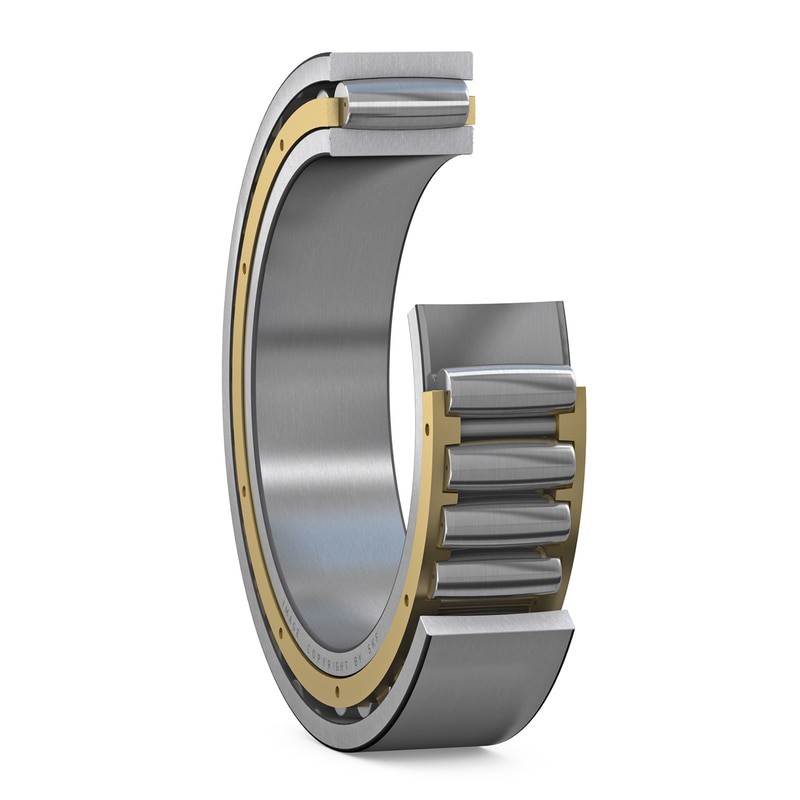
These bearings feature cylindrical-shaped rollers in linear contact with the raceways, but are not true cylinders. Instead, they have crowned or floating ends to relieve stress. You can find them in single- or double-row configurations. Still, regardless of your choice, their geometry gives them greater radial load capacity in high-speed applications. Nonetheless, they have moderate thrust load capacity.
Tapered Roller Bearings
Taper rollers are designed under the principle that cones can roll over each other without slipping. They contain an inner and outer ring and rows of non-separable cone assemblies. Conical tapered roller bearings run on conical raceways corresponding to the bearings' tapered design. Due to their sizeable surface-area contact, tapered rollers can withstand heavy radial, axial, and thrust loads, usually in moderate-speed applications. They closely resemble cylindrical bearings, but if you decide which one to purchase, here's the main difference: cylindrical roller bearings only handle limited thrust loads. At the same time, their tapered counterparts can manage significant thrust loads. Tapered roller bearings are usually available in inch and metric sizes.
Needle Roller Bearings
These rollers feature thin and long bearings positioned horizontally in the bearing casing. They may have tapered ends to maintain the roller position or hemispherical ends for free bearing movement. Needle bearings are a variant of cylindrical bearings. Their cup-style designs enable them to withstand high radial load capacities in applications requiring high-speed rotational accuracy. The primary advantage of needle rollers is their ability to use the mating surface as inner or outer raceways, or both. The construction also provides large oil reservoirs while maintaining a minimalistic cross-section design. You'll find needle rollers with or without an inner ring.
Thrust Roller Bearing
Thrust bearings are specific rotary bearings used to handle high loads in hostile environments. They may feature various rolling elements, including needles, tapered, spherical, or cylindrical rollers, which divide the bearing rings. Thrust rollers handle axial and thrust loads parallel to the shaft's axis. Their speed rating varies based on the rolling element used. For instance, ball roller thrust bearings are excellent for high-speed applications, but cylindrical roller thrust bearings are limited to moderate speeds.
Top 3 Reasons Why You Should Use Roller Bearings?
They Are Strong & Durable
Even though ball bearings handle misalignment better than roller bearings, roller bearings can manage more shock and impact. With their larger contact area, they're designed to be used with larger loads and lower speeds, and each roller bearing shape has its unique advantages. Tapered and spherical roller bearings in particular are best at managing combined radial and thrust loads, for example. Overall, roller bearings are the preferred solution for heavy-load industrial applications.
They Can be Greased or Lubricated
Even with the right care and maintenance, bearings eventually fatigue to the point of failure, and they should be monitored as part of your regular maintenance program. Predictive maintenance allows you to replace bearings when needed, instead of waiting for the entire machine to break down. In the meantime, proper lubrication is key to prolonging the service life of your bearings and ensuring optimum performance of your equipment.
There Are More Options Based on Geometry
There are different shapes of roller bearings suited to different operations:
Standard Cylindrical Roller Bearing: They don't work with thrust loads, but it's a trade-off for their greater radial load capacity. They're available in single, double, and multi-row options.
Needle Roller Bearing: These are similar to the cylindrical bearings, but they have a smaller diameter. This allows the needle roller bearing to be used for operations with less radial space, but it also means the bearing oscillates quickly and produces a lot of friction. Therefore, it's better suited to slow-moving equipment.
Tapered Roller Bearings: The tapered shape, which can have an angle of up to 30 degrees, is designed to accommodate thrust loading. The greater, the taper, the more axial load the bearing can tolerate. These are most commonly used in pairs.
Spherical Roller Bearings: Ideal for both axial loading and heavy shock loading, spherical bearings can manage a heavy load even when misaligned.
Applications of Roller Bearing

Agriculture
Roller bearings are widely used in the agricultural industry for their high load-carrying capacity and low frictional losses. They are used in applications such as tillage equipment, harvesters, tractors, and other heavy machinery. Roller bearings are essential components of these machines, providing reliable support and smooth operation of various moving parts. They have an advantage over traditional ball-bearing systems since they can handle larger loads more effectively without generating excessive heat or drag due to friction caused by rolling elements. In addition, roller bearings require less maintenance than ball bearings and offer greater durability when exposed to extreme temperatures and environments. This makes them ideal for agricultural applications that often operate in harsh conditions.
Aerospace
Roller bearings are also widely used in aerospace applications, particularly for aircraft engines, landing gears, and other components that require high levels of reliability and durability. These bearings are designed to withstand extreme operating conditions, such as those found in the aerospace industry. They can withstand vibrations and shock loads, as well as temperatures ranging from -184F (-120C) to 392F (200C). In addition to offering superior performance for challenging environments, roller bearings provide several design advantages. Their low-friction operation helps reduce wear on moving parts, which is essential when safety is paramount.
Manufacturing
Roller bearings in manufacturing are also used to improve machine accuracy and efficiency. The use of roller bearings can reduce the amount of energy required to produce a certain product while increasing its precision and accuracy. By reducing friction between moving parts, roller bearings can help extend the life expectancy of machinery, increase reliability and reduce downtime. Furthermore, the smooth operation of roller bearings reduces noise and vibration levels, resulting in a quieter work environment for personnel. This makes them ideal for use in industries such as automotive or aerospace engineering, where a consistent level of noise/vibration is critical. Overall, the application of roller bearings in manufacturing has numerous benefits that make them an essential component for any industrial process.
Industrial Machinery
Roller bearings are widely used in a variety of industrial machinery. They improve reliability, reduce maintenance costs and increase efficiency by providing smooth operation and reducing friction between moving parts. Roller bearings can be found in conveyors, motors, pumps, and other rotating equipment. Additionally, roller bearings play an important role in balancing the load on axles or shafts to prevent misalignment or damage to the machine. The use of roller bearings also helps extend the life of machines, as they help absorb shock and vibration from operating loads. With their robust construction and reliable performance, roller bearings are ideal for many industrial applications where longevity is desired. In conclusion, roller bearings offer numerous advantages over traditional bearing types due to their ability to handle higher loads with greater precision and reliability. They are, therefore, an ideal choice for industrial machinery applications where reliable operation and long-term performance are desired.
Medical
The medical industry highly values precision and accuracy, making roller bearings an ideal choice for various applications. Roller bearings offer extremely low-friction operation, as well as improved life expectancy when used in the correct conditions. This means that they can be used to ensure precise and accurate movements of delicate components within a variety of medical devices. In addition, roller bearings are particularly suitable for use in high-load applications such as wheelchairs and hospital beds. High load capacity is important to prevent breakdowns or premature failure, which could cause serious harm in a medical setting. Furthermore, because these components are exposed to extreme temperatures and varying levels of moisture during use, bearings with excellent corrosion resistance must be employed.
Marine
Roller bearings are used in various industries, including the marine industry. Marine applications of roller bearings often require special considerations due to the unique environment. These special considerations include corrosion resistance, shock and vibration tolerance, as well as water and oil compatibility. Roller bearings in marine applications must also be able to withstand extreme temperatures, ranging from hot to cold. To ensure that these requirements are met, it is important to select a bearing that is designed for use under these conditions. By using properly designed roller bearings in marine environments, businesses can reduce downtime while ensuring the safety and reliable operation of their equipment.
What Should be Considered When You Choose Roller Bearing
Find the Bearing Load & Load Capacity
Bearing loads are generally defined as the reaction force a component placed on a bearing when in use. When choosing the right bearing for your application, first you should find the bearing's load capacity. The load capacity is the amount of load a bearing can handle and is one of the most important factors when choosing a bearing. Bearing loads can either be axial (thrust), radial or a combination. An axial (or thrust) bearing load is when force is parallel to the axis of the shaft. A radial bearing load is when force is perpendicular to the shaft. Then a combination bearing load is when parallel and perpendicular forces produce an angular force relative to the shaft.
The Rotational Speed of Your Application
If your application will operate at high rotational speeds, then ball bearings are usually the preferred choice. They perform better at higher speeds and offer a higher speed range than roller bearings. One reason is that the contact between the rolling element and the raceways in a ball bearing is a point instead of a line of contact, like in roller bearings. Because rolling elements press into the raceway as they roll over the surface, there is much less surface deformation occurring in the point loads from ball bearings.
Centrifugal Force and Bearings
Centrifugal force is defined as a force that pushes outward on a body moving around a center and arises from the body's inertia. Centrifugal force is the main limiting factor to bearing speed because it turns into radial and axial loads on a bearing. Since roller bearings have more mass than a ball bearing, the roller bearing will produce a higher centrifugal force than a ball bearing of the same size.
Bearing Run out & Rigidity
Bearing run out is the amount a shaft orbits from its geometric center as it rotates. Some applications, like cutting tool spindles, will only allow a small deviation to occur on its rotating components. If you are engineering an application like this, then choose a high precision bearing because it will produce smaller system run-outs due to the tight tolerances the bearing was manufactured to. Bearing rigidity is the resistance to the force that causes the shaft to deviate from its axis, and plays a key role in minimizing shaft run out. Bearing rigidity comes from the interaction of the rolling element with the raceway. The more the rolling element is pressed into the raceway, causing elastic deformation, the higher the rigidity.
Bearing Lubrication
Knowing your bearing lubrication needs is important for choosing the right bearings and needs to be considered early in an application design. Improper lubrication is one of the most common causes for bearing failure. Lubrication creates a film of oil between the rolling element and the bearing raceway that helps prevent friction and overheating. The most common type of lubrication is grease, which consists of an oil with a thickening agent. The thickening agent keeps the oil in place, so it won't leave the bearing. As the ball (ball bearing) or roller (roller bearing) rolls over the grease, the thickening agent separates, leaving just the film of oil between the rolling element and the bearing raceway. After the rolling element passes by, the oil and thickening agent join back together.
Our Factory
Our factory offer standard the thin-section bearings, cross roller bearings, slewing bearing etc. With over 40 years of experience, we can design and manufacture various bearings with inner diameters ranging from 30mm to 6,000mm. Our precision grade can reach class P4 (ABEC7) or higher. We have bearings in stock or half-made rings ready for further production most of the time.

Ultimate FAQ Guide to Roller Bearing
Q: What Are Roller Bearings and Why Do They Matter?
A: Roller bearings are mechanical components designed to reduce friction between moving parts, facilitating smooth motion in machinery. Unlike plain bearings, which slide, roller bearings use cylindrical, needle-shaped, or tapered rollers to carry and distribute the load. This rolling action minimizes friction, heat generation, and wear, making roller bearings essential for the efficient operation of various industrial applications. Roller bearings are found in a wide range of machinery, including conveyor systems, automotive transmissions, industrial equipment, and even household appliances. They provide support and reduce wear and tear, ultimately improving the longevity and performance of machines.
Q: The materials used for rolling bearing
A: For special operating conditions, rolling bearings are available in the following designs: Made of stainless steel; hybrid bearings (two materials), where the bearing rings are made of steel, the rolling elements are made of ceramic; ceramic bearings, where both the bearing rings and the rolling elements are made of silicon nitride, zirconium oxide or silicon carbide; plastic bearings with rolling elements made of glass or ceramic against aggressive acids or alkalis in the chemical and food industries, and bearings with plastic cages for low-noise running.
Q: How Do I Avoid Premature Bearing Failure?
A: Selecting the Right Bearing. The bearing should be the right size and offer the correct load capacity for the machine.
Installing the Bearing Properly. The proper tools should be used during the bearing installation process. Additionally, the bearing should be installed as per the manufacturer's instructions. Once it is installed, it is essential to verify that all the components are properly aligned and positioned.
Lubricating the Bearing According to Manufacturer's Guidelines. Applying lubrication as per manufacturer guidelines helps ensure the bearing operates and performs as intended throughout its service life. It is important to use the right type of lubricant and apply the proper amount.
Installing the Bearing Properly. The proper tools should be used during the bearing installation process. Additionally, the bearing should be installed as per the manufacturer's instructions. Once it is installed, it is essential to verify that all the components are properly aligned and positioned.
Lubricating the Bearing According to Manufacturer's Guidelines. Applying lubrication as per manufacturer guidelines helps ensure the bearing operates and performs as intended throughout its service life. It is important to use the right type of lubricant and apply the proper amount.
Q: How do I choose roller bearing size?
A: The roller bearing size is selected based on the basic static load rating C0 (product tables). For an equivalent static bearing load P0, the selected bearing must have a C0 value equal to or larger than the value of the requisite basic static load rating C0req (table 1): P0 ≥ C.
Q: How Do Roller Bearings Work?
A: Roller bearings work by distributing the load over the rolling elements (rollers) rather than the entire surface, which reduces friction. When a load is applied, the rollers roll smoothly, minimizing resistance and enabling rotational motion. This mechanism ensures efficient and reliable operation.
Q: How to Install Roller Bearings Properly?
A: Proper installation is essential to maximize the lifespan and performance of roller bearings. It involves accurate alignment, adequate lubrication, and suitable mounting methods. Following manufacturer guidelines and industry best practices is crucial during installation.
Q: How to Maintain Roller Bearings?
A: Maintenance of roller bearings includes regular lubrication, inspection, and replacement if necessary. Lubricants must match the application's requirements, and inspections should identify signs of wear, misalignment, or damage.
Q: How Do I Determine Which Bearing Is Best Suited For My Application?
A: When choosing the specs for your design, we strongly recommend you get in touch with one of our bearing application engineers for assistance. We provide knowledgeable sales and expert personnel to assist in product design and selection, aiming to increase performance and ensure your company's success.
Q: How Exactly Does One Go About Measuring the Bearing Material's Hardness?
A: Rockwell, Brinell, Vickers, and Shore are some of the common scales used to measure a material's hardness. The Rockwell scale is often the one that is utilized for bearings. However, even within the Rockwell Hardness Test, several distinct scales are used to indicate the hardness level of various types of materials. Because bearings are often constructed from very hard materials, the Rockwell "C Scale" is the method of choice for determining the relative degree of hardness of bearing materials.
Q: How are bearings kept in place?
A: Typically, most plain bearings are installed by force. The holes they are supposed to fit in are tolerated slightly smaller than the outer diameter of the plain bearings. This way, the bearing is kept in place nice and secure by mechanical tension.
We're well-known as one of the leading roller bearing manufacturers and suppliers in China. If you're going to buy high quality roller bearing with competitive price, welcome to get more information from our factory.
340 520 180mm Bearing, CRA 5008 Bearing, Angular Contact Ball Bearing 25BNR19X